How Does An Elevator Work
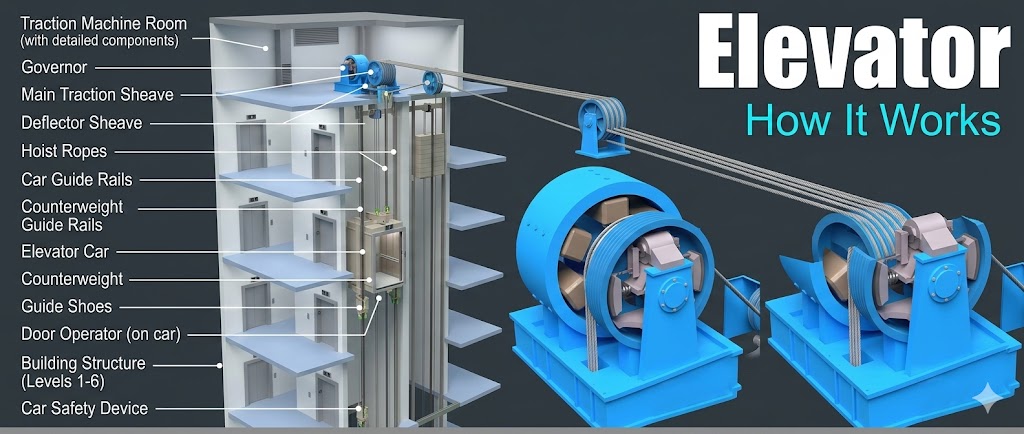
An elevator operates through a sophisticated system of mechanical and electrical components designed to move a car safely and efficiently between floors of a building.
The most common type, the traction elevator, uses steel ropes or belts that connect the elevator car to a counterweight, with both passing over a grooved wheel called a sheave that is driven by an electric motor; the counterweight,
which typically weighs the car plus 40-50% of its maximum load, balances the system so the motor only needs to overcome friction and the weight difference rather than lifting the full load.
When the motor turns the sheave, friction between the ropes and the grooves creates traction that moves the car upward while the counterweight descends, and reversing the motor direction lowers the car as the counterweight rises.
A separate braking system engages automatically when the car stops to hold it securely at each floor. For low-rise buildings, hydraulic elevators are common, using a piston pushed by pressurized fluid from an electric pump to lift the car,
with a valve opening to release fluid back to a reservoir for descent. Multiple safety systems protect passengers, including several hoisting cables—each capable of supporting the full load independently—plus a governor that activates
mechanical safety brakes on the guide rails if the car exceeds its rated speed, and buffers at the pit bottom to absorb impact in extreme scenarios.
Modern elevators incorporate regenerative drives that capture energy during braking and feed it back into the building’s electrical system, improving overall efficiency.